
MRDF — Microwave Rapid Development Framework
Emtera's proprietary design-and-build platform: same-day RF design release and delivered, tested hardware in 4–6 weeks — from 1 to 100 GHz.
RF development is the pacing item in modern defense systems.
Traditional cycles run 12–36 months, with high NRE and fragmented workflows. Emtera built MRDF to remove this bottleneck.
Every Emtera capability page mentions speed — designs in weeks, hardware in a month and a half. This page explains where that speed comes from. It is not heroics; it is a platform, built deliberately since 2021 and sharpened on every project since.
MRDF is why a program that would take a traditional RF house a year fits into a quarter at Emtera — and why the eleventh design in a recent program was faster than the first. The framework compounds: every build adds measured device data, characterized materials, and proven blocks to the library the next design starts from.
A systematic design methodology that leverages proven materials, PCB stackups, fabrication processes, and accumulated design experience to rapidly develop optimized RF and antenna solutions — selecting custom or commercial components as each application demands.
How MRDF works
Requirements Analysis
Performance requirements drive the design approach. The framework analyzes the problem and identifies the optimal path — not the other way around.
Design Exploration
Leverage accumulated experience, prior designs, and a proprietary library of measured device and material characteristics to rapidly converge on an optimized architecture.
Component Selection
Custom semiconductors when the application demands it (e.g., a Ka-band ESA's PA, LNA, and phase shifters). Commercial off-the-shelf parts when they meet requirements — faster, lower cost.
Proven Materials & Process
Proprietary test structures on every build characterize actual material performance. Validated stackups and proven fabrication processes eliminate risk.
Rapid Build, Test, Deliver
Automated test frameworks and proven production processes enable fast turnaround from design release to delivered, tested hardware.
Proven foundation
- Proprietary test structures in every build — all materials independently characterized, never taken from vendor specs
- A deep library of measured device and material data, accumulated across every project — each job adds to the collective knowledge
- Vendor accountability enforced through measured dielectric-constant and insertion-loss data, DC–40 GHz
- Simulation models calibrated against measured hardware
- Standardized test fixtures and automated measurement
- Production-ready test frameworks — often under one minute per unit
Adaptable to each application
- New geometries and novel designs — not just pulling from a library of existing products
- Custom semiconductors when the application demands it; COTS when they meet requirements
- Active or passive: ESAs, flat panels, waveguide, shaped reflectors, spirals, anti-jam arrays
- Frequency range driven by requirements: 300 MHz to 70+ GHz antennas, 1–100 GHz RF modules
- Environmental requirements: MIL-STD, IP67, NASA GEVS, space-qualified
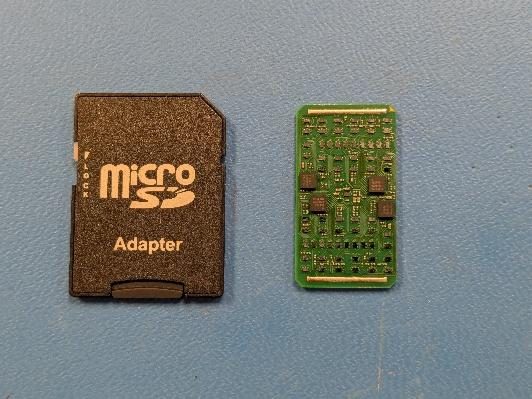
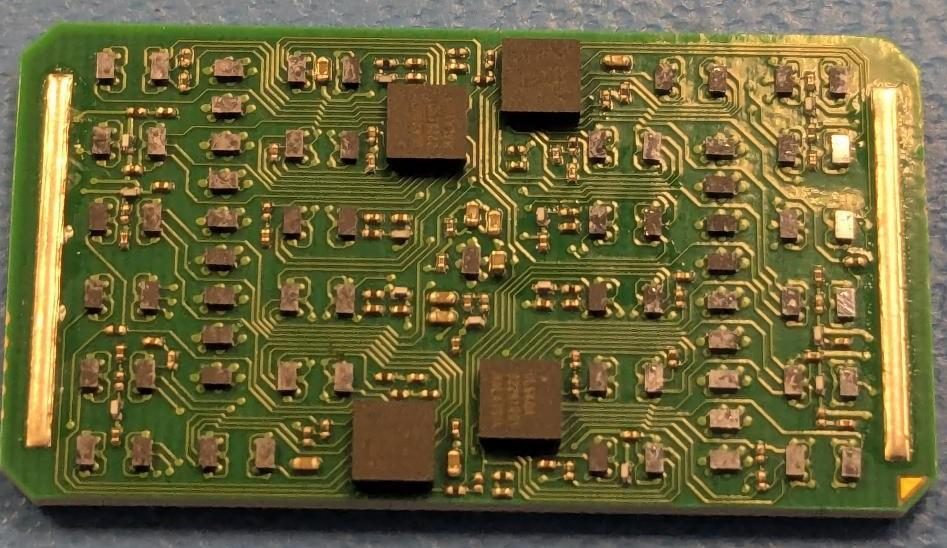
The MicroModule: MMICs without the MMIC
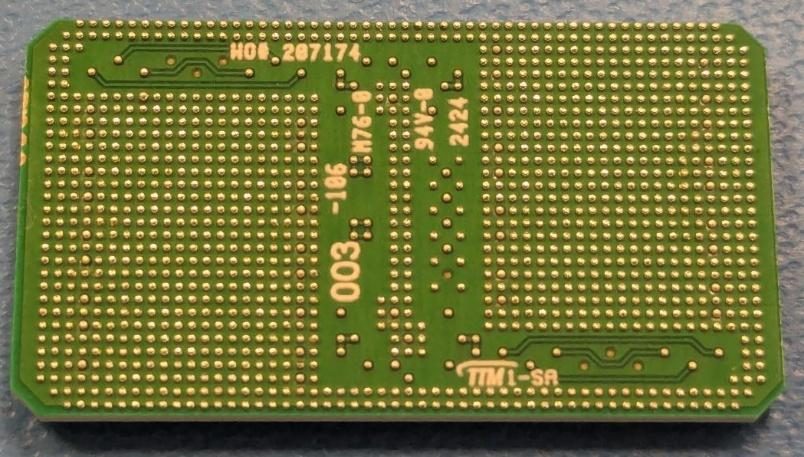
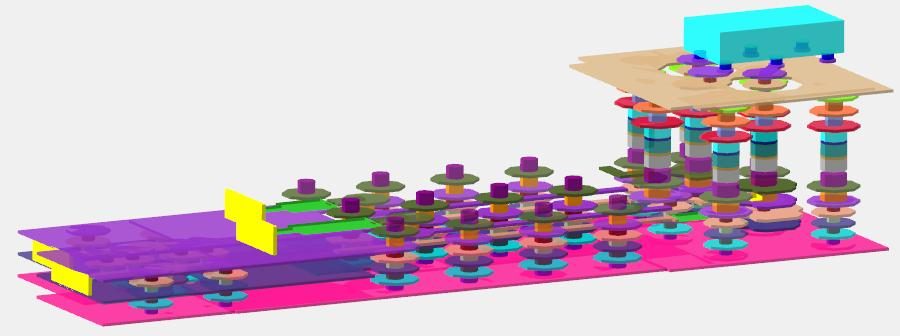
At the heart of MRDF is the MicroModule — a shielded 3D assembly that eliminates the half-year-to-two-year MMIC development cycle for a large class of RF problems.
- All RF paths run inside the module's 3D volume, fully shielded in individual copper Faraday cages — only digital and power traces are visible from outside
- Passives — the frequency-determining elements of a MMIC — live in the module volume instead of expensive semiconductor wafer area, so frequency is customizable on a 2–4 week fabrication cycle
- Pretested, inventoried semiconductor devices (transition frequencies above 130 GHz) with frequency-agnostic footprints;
GaAs,GaN, andSiGemix freely within a functional block - 3D copper shielding eliminates radiation losses — higher Q than MMIC passives — and permits very tight integration without cross-coupling between channels
- Integrated micro-FPGAs provide ~50-microsecond switching and high-fanout control as a seamless part of the module
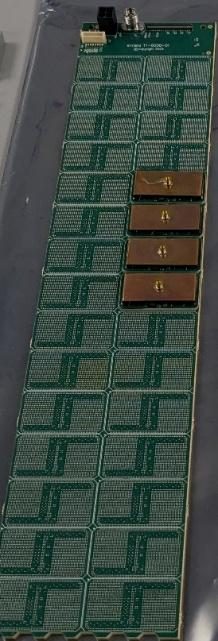
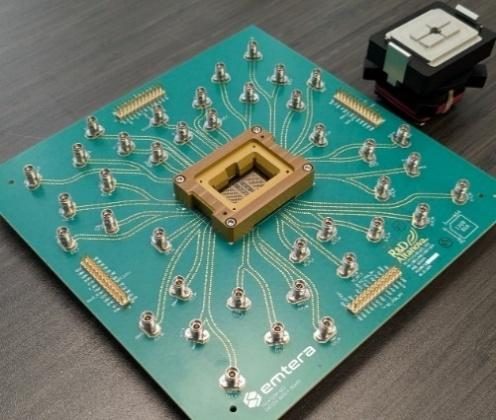
- Ultra-fine-pitch BGA super-assembly for DC–100 GHz interconnection, with standardized footprints and eval carrier boards
- 100% automated testing is included inside the 4–6 week fabrication cycle
The functional-block library — low-noise amplifiers, low-loss RF switches, phase shifters, high-Q filters, directional couplers — is continuously scalable in center frequency from 1 to 100 GHz. Designs are composed at block-diagram level with full performance prediction from as-measured data, and layout is automated.
Every build makes the next one faster.
MRDF compounds. Each project adds measured device data, characterized materials, and proven functional blocks to the library the next design starts from — which is why the eleventh design in a recent program shipped faster than the first.
See our capabilitiesHave a project or a question?
Tell us what you're building — an engineer will get back to you.
Email contact@emtera.com